What can we do about climate?
Here are some ideas, solutions and resources connected with climate and climate change.
Looking for ideas about climate…
Here are some ideas, solutions and resources connected with climate and climate change.
Climate Base Job Advert
Sustainability strategy outline
Business sustainability conversation starter
All my bookmarks on climate change, sustainability, science and technology
How to be a sustainability consultant course on Udemy
Chris Martenson Crash Course – primer in energy, envronment and the economy
For too long, climate change has been viewed solely as an environmental issue. Yet, the deeper we delve into its repercussions, the clearer it becomes that it is also a profound societal challenge, weaving together threads of inequality, economic disparity, and potential societal upheaval.
At its core, climate change refers to the long-term alteration of temperature and typical weather patterns in a place. Caused predominantly by human activities, especially the burning of fossil fuels, deforestation, and industrial processes, the Earth’s average temperature has risen significantly.
One cannot discuss climate change without mentioning its socio-economic implications. Historically, vulnerable communities bear the brunt of environmental changes, while affluent ones are better equipped to adapt or move. This pattern continues with climate change.
As these challenges mount, societal structures are put under immense strain. Economic challenges, food shortages, and health crises can lead to mass migrations, which in turn, can strain resources in other regions, potentially leading to conflict and societal collapse.
It is not all doom and gloom. By recognising the intertwined nature of climate change and societal structures, we can develop holistic solutions.
Understanding the intricate relationship between climate change, inequality, and potential societal collapse is essential for shaping a future where all can thrive. By addressing these interconnected challenges, we can hope to build a more resilient, equitable, and sustainable world for future generations. It is high time that global communities unite, prioritise, and act collectively to mitigate these impending threats.
As we dissect the impacts of climate change further, its role in magnifying economic disparities becomes increasingly evident. The world, although globalised, remains financially divided with climate change exacerbating the divide.
The patterns of global trade are intricately linked with climate. As regions face irregular weather patterns, the production of primary goods such as crops, timber, and minerals is affected.
Communities dependent on climate-sensitive sectors like agriculture, fisheries, and forestry face a direct threat to their livelihoods.
Financial markets, although seemingly detached, are closely linked with the real-world implications of climate change.
While the challenges are vast, human ingenuity and technological advancements offer a beacon of hope.
Adoption of sustainable technologies can mitigate the impacts of climate change. Solar panels, wind turbines, and electric vehicles are not only environmentally friendlier but also economically viable in the long run.
Harnessing the power of big data and predictive analysis can help in better preparation and response to climatic events. From predicting crop yields to modelling the spread of climate-induced diseases, data-driven decisions can be game-changers.
Empowering local communities to develop and implement solutions tailored to their specific needs can lead to sustainable and long-lasting results.
The relationship between climate change, economic disparity, and societal structures is a complex web. However, by viewing this challenge as an opportunity, we can harness our collective intelligence and resources to pave the way for a balanced, equitable, and sustainable future. The time to act is now, and every effort, no matter how small, counts in this global endeavour.


Public-Facing Solution Story
A practical, human-centred domestic blueprint for safeguarding biodiversity where we live.
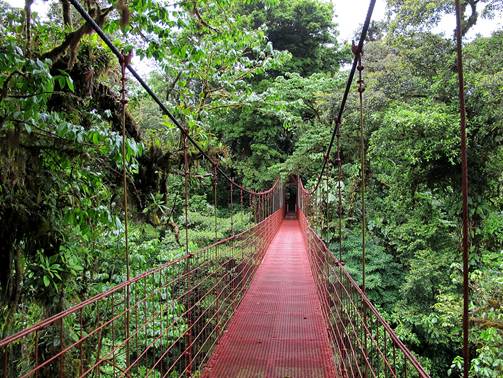
A practical domestic solution to biodiversity loss: build a connected network of well-run reserves on land, in fresh water and at sea.
Image credit: Haakon S. Krohn, “Monteverde puente”, Wikimedia Commons, CC BY-SA 3.0. https://commons.wikimedia.org/wiki/File:Monteverde_puente.jpg
Protect the habitats that wildlife needs most, then manage them properly. A reserve is more than a line on a map: it needs local consent, clear rules, trained people, reliable funding and checks that nature is actually recovering.
The practical aim is a connected safety net of forests, wetlands, rivers, coasts and sea areas that keeps species, water supplies and livelihoods more resilient.
Costa Rica’s National System of Conservation Areas (SINAC)
End with the most important lesson:
Protecting more places matters—but the places must be chosen well, connected, properly funded and run with the people who depend on them.
What is happening? Wild species are losing the places where they feed, breed and move. Forest clearing, damaged rivers, destructive fishing and roads can split habitats into small islands that cannot support healthy populations.
Why should we care? Healthy habitats support food, clean water, coastal protection, pollination, recreation and local livelihoods. When they fail, households and public services often pay the price.
Why is this solution worth knowing about? Protected areas can hold the core habitats that nature needs while creating a practical framework for stewardship. The global goal is not simply to count hectares; it is to conserve the right places effectively, fairly and as a connected system.
Plain language note: “effective management” means having people, money, rules and local support to achieve conservation results—not just an official designation.
You do not need to solve everything at once. Start with a short, public plan for the places nature needs most, then build it step by step.
Bring together local knowledge and current maps of threatened species, nesting or spawning grounds, intact habitats, drinking-water sources, floodplains and migration routes. Identify gaps in the existing network before selecting new sites.
Work with Indigenous peoples, local residents, fishers, farmers and landholders from the start. Respect land and resource rights, obtain free, prior and informed consent where applicable, decide which uses are compatible with conservation, and set out fair benefit-sharing arrangements.
Use a mix of strict reserves, community-managed areas, sustainable-use zones and wildlife corridors. Link land, rivers, coasts and sea areas so that species can move and ecosystems can cope better with heat, storms and other change.
Budget for rangers, local monitors, equipment, ecological surveys, restoration and dispute resolution. Pair transparent enforcement with education and incentives; do not rely on penalties alone.
Publish a baseline and a simple annual scorecard: habitat condition, key species, illegal activity, local benefits and management actions completed. Review boundaries and rules when the evidence shows a gap or a failure.
Start small. A town, catchment group or coastal community can begin by mapping one threatened habitat, convening the people affected and agreeing one feasible protection-and-management action while national measures are pursued.
| If we do this… | We could see… |
| Select new sites from evidence and local knowledge, not convenience. | More of the habitats, species ranges and migration routes that are currently missed by the network are protected. |
| Fund rangers, community monitoring, maintenance and fair enforcement. | Fewer “paper parks” and a clearer link between the designation of a site and real conservation work on the ground or at sea. |
| Track habitat condition, key species and local outcomes, then adjust. | Public evidence for expanding, improving or changing a reserve instead of relying on promises or area totals alone. |
Measured example: Costa Rica’s September 2026 protected-area profile records 13,548 km² of land and inland waters and 165,109 km² of marine and coastal waters within protected areas. Those coverage figures are management indicators, not proof on their own that every species is recovering.
No solution is perfect.
The honest test is not “how much land or sea was labelled protected?” but “which places are healthier, who shares the benefits, and what does the monitoring show?”
Three reliable sources for readers who want the full story.
Plain-language guidance on conserving 30% of land, inland waters, coasts and seas effectively, fairly and as a connected system.
Read more → https://www.cbd.int/gbf/targets/3/
The current World Database on Protected and Conserved Areas profile for Costa Rica, including coverage and recorded management-effectiveness evaluations.
Read more → https://www.protectedplanet.net/en/country/CRI
A peer-reviewed assessment showing why species representation and range coverage are more informative than simply adding up protected-area totals.
Read more → https://pmc.ncbi.nlm.nih.gov/articles/PMC4430271/
Where has this been tried? Protected-area networks operate worldwide. This story draws its practical example from Costa Rica, where SINAC has linked protected areas with wider forest, wildlife, water and watershed governance across 11 conservation areas.
What does the evidence show? The Costa Rican case demonstrates that a national system can reach substantial land and marine coverage and make management evaluation routine. Its forest recovery has also been associated with a broader policy mix that included protected-area governance, incentives, restoration and monitoring—not protected areas alone.
How strong is the evidence? The case is supported by official institutional and protected-area data, a World Bank synthesis and peer-reviewed research. The research also provides an important warning: a 2015 mammal study found 98.5% of species present in at least one protected area, yet 25% were underprotected against representation targets.
What do we not know yet? Coverage does not reveal whether rules are enforced consistently, whether each site is adequately resourced, or whether every group shares costs and benefits fairly. Ecological effects vary by species, habitat and pressure, so outcome monitoring must continue.
| At a glance | Details |
| Problem | Biodiversity loss from habitat destruction, fragmentation, overuse and weak protection. |
| Solution | A connected, equitably governed and well-managed network of protected land, freshwater and sea areas. |
| Works at | National, regional and local levels; connections across boundaries make it stronger. |
| Typical timescale | 1–3 years to map, agree and designate priority sites; ongoing management; 5–10+ years for many ecological outcomes. |
| Approximate cost | Moderate to high and recurrent. Costs include planning, rights and benefit arrangements, staffing, monitoring, restoration and enforcement. |
| Evidence | Strong conservation rationale; outcome evidence is mixed and context-dependent. Coverage alone is not an outcome. |
| Main benefit | Secures core habitat and ecosystem services while creating a durable framework for local stewardship. |
| Main limitation | Can become a “paper park” or create unfair burdens if funding, rights and accountability are weak. |
Library note: This story follows the public-facing format of the GSTIA Open Library of practical solutions to the polycrisis.
Editorial principle: This is an evidence-grounded public guide, not an academic review. It reports what appears to work, where it works, what it costs and where the evidence remains uncertain.
A globally-grounded early years curriculum for children aged 5–7, built on the world’s best evidence-based practices in holistic education.
35 complete lesson plans across 7 essential life skills. Click any section to expand, then copy directly into your WordPress site.
Every lesson in this curriculum is grounded in these principles, drawn from the world’s leading early years education systems.
Life skills — not literacy drills — are the explicit focus of the early years. Reading and numeracy emerge from a foundation of emotional security and curiosity.
Teachers are reflective practitioners with deep knowledge of child development. They are given professional autonomy rather than scripted delivery.
Every child, regardless of background, has the right to a rich, holistic early education. No child is excluded from the conditions that support life skills development.
Structured and unstructured play is the primary vehicle for developing all seven life skills. Play is not a break from learning — it is the learning.
Daily outdoor learning is a curriculum requirement. Environmental awareness is built through direct, sensory experience in the natural world.
Parents, caregivers, and community members are active partners in each child’s learning journey. The classroom extends beyond four walls.
Children have genuine voice in decisions about their own learning. Their ideas, preferences, and questions shape the curriculum in real time.
Emotion-first, play-based learning; sisu & tunteiden säätely; delayed formal academics until age 7
Te Whāriki framework; bicultural curriculum; family and community as co-educators
Fællesskab (community); democratic formation; no grades before age 14; emotion as curriculum
Friluftsliv outdoor tradition; children’s rights in law; multicultural integration
Sustainability from age 1; active citizenship; global citizenship education; Lpfö 18
Click any skill to jump to its full section with lesson plans, or use the navigation above.
Every section and lesson plan has a Copy for WordPress button. The copied content is clean HTML ready to paste into a WordPress HTML block.
Use any “Copy for WordPress” button — per lesson, per skill section, or the full curriculum from the top navigation.
In your WordPress editor, add a new HTML block (or switch to HTML view in the Classic Editor).
Paste the copied HTML. Apply your theme’s heading and paragraph styles as needed. All structure is preserved.
Communication is the foundation of all human connection. For children aged 5–7, developing communication skills means far more than learning to read and write — it means learning to express their inner world, to listen with genuine attention, to ask questions, and to understand that their voice has value. Finland’s approach of modelling open emotional dialogue, New Zealand’s bicultural communication strand, and Sweden’s emphasis on global citizenship all point to the same conclusion: communication is relational, not merely technical.
Inspired by: Finnish open-dialogue practice; New Zealand’s Te Whāriki Communication strand
One smooth, palm-sized stone (the ‘talking stone’); a circle of floor cushions or chairs; a simple prompt card for the educator.
Gather children in a circle on cushions. Hold up the talking stone and explain: ‘In our classroom, whoever holds this stone has the floor — everyone else’s job is to listen with their whole body: eyes watching, ears open, heart ready.’ Demonstrate what ‘whole body listening’ looks like by modelling it yourself.
Begin by holding the stone yourself and sharing a simple, genuine thought. Pass the stone around the circle. Each child may speak or pass — there is no pressure. After each child speaks, the group gives a silent acknowledgement — a gentle nod or a soft clap — before the stone moves on.
Once the stone has travelled the circle, invite open discussion: ‘Did anyone hear something that surprised them? What did it feel like to be listened to?’ Record children’s responses on a large sheet of paper.
Place the talking stone in a visible spot in the classroom. Explain that it will always be available — any child who wants to share something important can pick it up.
Children draw or paint a picture of ‘something I noticed today’ and dictate a sentence to the educator to add beneath it. These are displayed at child height in the classroom.
Observe and note which children speak with confidence, which pass, and which seem to want to speak but hesitate. This informs future grouping and individual support.
Inspired by: Finnish emotional dialogue practice; Danish emotion-as-curriculum approach
A large illustrated ‘weather chart’ with weather symbols each paired with an emotion word (sunny = happy, stormy = angry, foggy = confused); individual weather cards for each child; a display board.
Introduce the weather chart. Ask: ‘Have you ever noticed that your feelings are a bit like the weather? Sometimes you feel bright and sunny inside. Sometimes you feel stormy.’ Read through each symbol together.
Give each child their own weather card. Ask them to choose the weather that best matches how they feel right now and place it on the display board beside their name. Emphasise that there is no wrong answer.
Look at the board together. ‘I notice we have lots of different weathers in our classroom today. That’s what makes our group interesting.’ Ask: ‘Has anyone ever felt two weathers at the same time?’
Explain that the weather board will be updated every morning. ‘Each day when you arrive, you can change your weather. And if your weather changes during the day, you can change it then too.’
Children create their own personal ‘weather book’ — a small folded booklet in which they draw their weather each day for a week and dictate a sentence about why.
The daily weather board is itself an ongoing assessment tool. Educators note patterns over time — a child who consistently chooses stormy or foggy weather may need additional emotional support.
Inspired by: Swedish global citizenship communication; New Zealand’s multi-modal communication strand
A wordless picture book (e.g., The Red Book by Barbara Lehman, or Flotsam by David Wiesner); drawing paper; pencils and crayons.
Hold up the wordless picture book. ‘This book has no words at all. How do you think we’ll know what’s happening in the story?’ Take a few responses.
Read through the book slowly, pausing on each page. Ask: ‘What do you think is happening here? How do you know? What is this character feeling? How can you tell without any words?’
Ask children to create their own wordless story — a sequence of three drawings that tell a story with no words. The only rule: a stranger should be able to understand what is happening just by looking.
Invite volunteers to share their wordless story with the group. The group tries to ‘read’ the story before the creator explains it. Celebrate moments where the visual communication worked perfectly.
The class creates a ‘silent message wall’ — a display of drawings, symbols, and images that communicate something important without words. Families are invited to contribute.
Observe the sophistication of children’s visual storytelling — are they using facial expressions, sequential action, and context? Note children who find visual communication particularly natural.
Inspired by: Danish cooperative dialogue practice; Norwegian democratic participation
Pairs of chairs facing each other; a sand timer (2 minutes); a simple ‘listener checklist’ drawn on the board.
Ask: ‘Has anyone ever been talking to someone and you could tell they weren’t really listening? What did that feel like?’ Today we’re going to practise being the best listeners in the world.
Ask a confident child to sit with you. Demonstrate bad listening first — looking away, fidgeting, interrupting. Then demonstrate excellent listening — full eye contact, still body, nodding, asking one genuine question.
Arrange children in pairs. Round 1: Partner A speaks for 2 minutes about ‘a place that makes me feel happy.’ Partner B listens using the checklist. When the timer ends, Partner B asks one genuine question. Then swap. Round 2: Topic is ‘something I find difficult.’
Bring the group back together. ‘What was hard about listening for two whole minutes without interrupting? What did it feel like to have someone’s full attention?’ Introduce the saying: ‘We have two ears and one mouth.’
Children write or dictate ‘A portrait of my partner’ — three things they learned about their partner through listening. These are displayed alongside photographs of the pairs.
Observe listening behaviour during the partner activity. Note children who find sustained listening particularly challenging — this is valuable information for social-emotional support planning.
Inspired by: New Zealand’s te reo Māori integration; Sweden’s global citizenship communication
A large world map; sticky dots in different colours; index cards; markers; multilingual picture books if available.
Send a note home to families asking them to teach their child how to say ‘hello,’ ‘thank you,’ and ‘you are my friend’ in their home language.
Spread the world map on the floor. Ask each child to place a sticky dot on the country where their family comes from. Step back and look at the map together: ‘Look at all the places our classroom comes from.’
Go around the circle. Each child shares their greeting in their home language. The whole group repeats it together. Write each greeting on an index card and attach it to the map. Celebrate every language equally.
In small groups, children create a ‘Hello Book’ — a simple folded booklet in which they draw themselves saying hello in each language they have learned today. Display all greeting cards around the classroom.
Families are invited to come in and teach the class a song, game, or story from their culture. This becomes a regular ‘Family Friday’ feature.
Note children who light up when their home language is recognised — and children who seem uncertain or hesitant about their linguistic identity. Both responses are important data for building an inclusive classroom culture.
Empathy — the capacity to understand and share the feelings of another — is the cornerstone of all healthy relationships, communities, and societies. Denmark’s explicit teaching of empathy as a curriculum subject (the Klassens tid tradition), Finland’s focus on emotional literacy, and New Zealand’s relational pedagogy all reflect the same understanding: empathy is not innate — it is learned, and it must be taught intentionally and early.
Inspired by: Danish Klassens tid empathy curriculum; Finnish emotional literacy practice
A set of large illustrated scenario cards showing children in various emotional situations; a simple ‘Empathy Map’ template for each child (four quadrants: What do they see? What do they hear? What do they feel? What do they need?); markers.
Ask: ‘Has anyone ever looked at someone and just known they were sad, even before they said anything? How did you know?’ Today we’re going to practise the skill of reading what someone else is feeling.
Show the first scenario card. Model completing the Empathy Map aloud: ‘This child is sitting alone at lunch. What do they see? Probably other children laughing together. What do they hear? Noise all around them, but no one talking to them. What do they feel? Probably lonely, maybe a bit sad. What do they need? Maybe someone to sit with them, or to say hello.’
Groups of 3–4 receive a scenario card and complete an Empathy Map together. Groups share their maps with the class.
‘Empathy doesn’t mean you have to fix everything. Sometimes the most empathic thing you can do is simply notice, and let someone know you’ve noticed.’
Inspired by: Danish perspective-taking curriculum; Norwegian multicultural integration
Hold up a pair of shoes. ‘There’s a saying: before you judge someone, walk a mile in their shoes. What do you think that means?’
Present a scenario: ‘It’s the first day at a new school.’ Assign roles: the new child, a child who is shy, a child who is confident, a child who is unkind, a child who is kind. Act out the scenario. Then rotate roles so children experience it from multiple perspectives.
‘Which role felt most comfortable? Which was hardest? Did your feelings change when you changed roles? What did you learn about the new child’s experience?’
Inspired by: Finnish emotional vocabulary practice; Danish emotion-as-curriculum
Write ‘happy’ on the board. Ask: ‘Can you think of other words that mean something like happy but not exactly the same?’ Build a word cloud: joyful, content, excited, proud, relieved, grateful, peaceful. ‘Each of these is a different feeling. Having the right word helps you understand yourself and helps others understand you.’
Each child creates a personal ‘Feelings Library’ — a small booklet with one feeling per page. They draw a face showing the feeling, write or dictate the word, and add a sentence: ‘I feel [word] when…’ Aim for at least 8–10 feelings.
Share new words. ‘From today, when you want to tell someone how you feel, try to find the most precise word you can. Your Feelings Library can help.’
Inspired by: Swedish active citizenship; New Zealand’s Contribution strand
Drop a stone into a bowl of water. ‘Watch the ripples. One small action creates rings that spread outward. Kindness works the same way — one act of kindness can ripple through an entire community.’
Each child writes or dictates one specific act of kindness they will do for someone today — not a vague ‘be nice’ but something specific: ‘I will sit with [name] at lunch because they usually sit alone.’ ‘I will help [name] tidy up without being asked.’ Children carry out their act during the day.
At end of day: ‘Did you do your kind act? What happened? How did the other person respond? How did you feel?’
Inspired by: Finnish emotional self-regulation; Danish care and wellbeing curriculum
‘When you feel sad or upset, what helps you feel better?’ Take responses: a hug, being alone, talking, music, drawing. ‘Notice that everyone said something different. That’s very important.’
Each child creates their personal ‘Comfort Toolkit’ — a small illustrated card showing 3–5 things that help them feel better. These are laminated and kept in a special place in the classroom. Children also write one thing they can offer to a friend who is upset.
‘Before you try to comfort someone, it’s kind to ask: What do you need right now? Because what helps you might not help them. Real empathy means finding out what the other person needs, not just giving them what you would want.’
Resilience is not toughness — it is the capacity to face difficulty with the support of trusted relationships, to persist through challenge, and to recover from setbacks. Finland’s concept of sisu, Norway’s outdoor resilience-building through friluftsliv, and Denmark’s deliberate removal of grades and competition all point to the same understanding: resilience grows in environments of safety, trust, and appropriate challenge — not pressure and fear.
Inspired by: Finnish sisu concept; Norwegian outdoor resilience tradition
If a balance board is available, invite children to try standing on it. Notice together: ‘Everyone wobbles. Some people wobble a lot. Some people fall off. But what happens after the wobble?’ (They try again, they adjust, they get better.)
Share a personal story about a time when something was really hard and you wanted to give up — but you didn’t. Describe the wobble and what helped.
Give each child a strip of paper. Ask them to complete: ‘I wobbled when _______, and then I _______.’ Display all strips on the Resilience Wall.
‘Look at this wall. Every single person in this room has wobbled and kept going. That is what resilience looks like.’
Inspired by: Danish no-grades-before-14 philosophy; Finnish trust-based learning culture
Share stories of famous mistakes that became great discoveries: Post-it Notes, penicillin, chocolate chip cookies. ‘Did you know that Post-it Notes were invented because someone made a glue that wasn’t sticky enough?’
Each child creates a ‘Museum Exhibit’ for a mistake they made. The exhibit card includes: what they were trying to do, what went wrong, what they felt, and what they discovered because of the mistake.
Children walk through the museum and leave a sticky note on one exhibit that resonates with them. ‘From today, our classroom is a place where mistakes are welcome.’
Inspired by: Norwegian friluftsliv outdoor resilience; Finnish outdoor learning in all seasons
‘Today we’re going outside to build a shelter. When things get hard — and they will — I want you to notice what happens in your body and what you do next.’
Teams of 3–4 build a shelter using only natural materials. The educator introduces deliberate challenges: ‘Your team has just lost one builder. A storm has knocked down part of your shelter. What now?’
‘What happened when things got hard? What did you feel? What did you do? What helped your team keep going?’
Inspired by: Finnish sisu and tunteiden säätely; Swedish active citizenship and self-regulation
Introduce two puppet characters: the Helpful Voice (‘I can try, It’s okay to make mistakes’) and the Unhelpful Voice (‘I can’t do this, I give up’).
Each child writes or draws an unhelpful thing their inner voice sometimes says, then what the Helpful Voice could say instead.
Each child creates their personal resilience phrase: ‘I haven’t got it yet.’ ‘Wobbling means I’m learning.’ ‘I am brave enough to try.’
Inspired by: Finnish play-based persistence; Danish child-initiated learning
‘For the next four weeks, you are going to grow something from a seed. You will water it, observe it, and record what you notice. Some days nothing will seem to be happening. That is the hardest part — waiting and trusting.’ Plant seeds together.
Each week, children water their plant, observe changes, and make a journal entry. The class chart is updated together.
Children share Growth Journals and reflect: ‘What was the hardest week? Was there a moment you wanted to give up? What kept you going?’
Curiosity is the engine of all learning. When children are genuinely curious, they are intrinsically motivated, deeply engaged, and capable of sustained concentration. Finland’s decision to delay formal academics until age 7, New Zealand’s ‘Exploration’ curriculum strand, and Denmark’s legal requirement for sensory-rich, imagination-supporting environments all reflect a shared conviction: curiosity must be protected, not extinguished, in the early years.
Inspired by: New Zealand’s Exploration strand; Danish sensory-rich environment requirement
Share something that genuinely makes you wonder. Model writing a wonder question on a sticky note: ‘I wonder why the sky is blue at noon but orange at sunset.’ Invite children to share their own wonder questions. Three colours: yellow = I wonder why…; blue = I wonder how…; pink = I wonder what would happen if…
Each morning, children have 5 minutes to add a new wonder question. Once a week, the class selects one question from the Wonder Jar to investigate together.
‘Have any of our questions been answered? Have any of our answers led to new questions?’ Celebrate the growth of curiosity over time.
Inspired by: Norwegian friluftsliv outdoor inquiry; Finnish Environment and Nature curriculum strand
‘Scientists are professional wonderers. Their job is to look at the world very, very carefully and write down exactly what they notice — not what they think they should see, but what is actually there. Today, you are all scientists.’
Give each child a natural object and magnifying glass. 5 minutes just looking — no drawing yet. Then: ‘What do you notice? What surprises you?’ Children draw in as much detail as possible.
In pairs, share notebooks. ‘Did you notice anything your partner missed?’ The Scientist’s Notebook is theirs for the whole year.
Inspired by: Danish sensory-rich environment legislation; Finnish play-based discovery
‘Today there are no instructions. There is no right answer. There is no finished product you’re supposed to make. Your only job is to explore, create, discover, and wonder.’
Step back and observe. Resist the urge to direct or suggest. Loose parts: stones, shells, corks, fabric scraps, wooden blocks, buttons, wire, tubes, mirrors, magnets, string, clay, water, sand, seeds, leaves, pinecones.
‘What did you discover? Did anything surprise you? What questions did you end up with?’
Inspired by: Norwegian friluftsliv; Finnish outdoor learning; Swedish sustainability curiosity
‘Your mission is to ask as many questions as you can. Every time you notice something and wonder about it, that’s a question. We’re going to count our questions.’
Walk slowly through the outdoor space. Stop frequently. Prompt: ‘What do you notice? What’s different from last week? What’s happening here?’ Children record questions in notebooks.
Count the questions. ‘We asked [X] questions today. That is [X] more things we want to understand about the world.’ Select one to investigate next week.
Inspired by: Swedish community-connected learning; New Zealand’s family-as-co-educator model
Announce the expert visit — a parent, community member, or local professional (beekeeper, chef, builder, musician, doctor, gardener). Spend one session generating questions as a class.
Children take turns asking prepared questions. Encourage follow-up: ‘That’s interesting — can you tell us more? What do you still wonder about?’
‘What did you learn that you didn’t know before? What new questions do you have now?’ Create a collective thank-you.
Self-responsibility — the understanding that one’s choices and actions have consequences, and that one has the agency to make good choices — is the foundation of ethical behaviour and lifelong self-management. Norway’s legal embedding of children’s right to participate in decisions about their own learning, Sweden’s Lpfö 18 curriculum’s emphasis on active civic participation, and Finland’s removal of external grading pressure all reflect a shared belief: children develop responsibility when they are genuinely trusted with it.
Inspired by: Danish democratic formation; Norwegian children’s right to participate; Swedish active citizenship
‘What would our classroom need to feel like a good place for everyone?’ Take responses on sticky notes. Guide children toward principles rather than rules: ‘Be kind’ rather than ‘No hitting.’
Together, draft 5–7 agreements in the children’s own language. Use the voting system to confirm each one. Once agreed, each child signs or makes their mark on the agreement.
Return to the agreement when conflicts arise: ‘Let’s look at what we agreed together. What do we think happened here?’
Inspired by: Norwegian children’s right to participation; Swedish Lpfö 18 active participation emphasis
Use a scenario card: ‘You’re building a tower and your friend accidentally knocks it over.’ Map out two choices and trace the consequences of each on the map.
Groups receive a scenario card and create their own Choice Map, tracing at least two possible choices and their consequences.
‘Self-responsibility means understanding that your choices matter — to you and to the people around you.’
Inspired by: Finnish cooperative classroom culture; New Zealand’s child-as-active-agent model
Introduce each job on the rota: Plant Waterer, Door Holder, Snack Helper, Book Organiser, Weather Reporter, Tidy-Up Captain, Welcome Greeter. For each one: ‘Why does this job matter? What would happen if nobody did it?’
Children check their job for the day and carry it out. Jobs rotate weekly. Celebrate contributions publicly and specifically.
Inspired by: Danish ethical care model; Finnish emotional self-regulation practice
Explore the difference between a quick ‘Sorry’ and a genuine apology using the framework: 1. I did/said ______. 2. I understand that made you feel ______. 3. I am sorry because ______. 4. Next time, I will ______.
In pairs, practise giving and receiving genuine apologies using the framework and scenario cards.
‘Taking responsibility for something you did wrong is one of the bravest things a person can do. It’s not about feeling bad about yourself — it’s about caring about the other person.’
Inspired by: Norwegian children’s right to participate; New Zealand’s child-as-co-constructor model
‘In this classroom, your learning belongs to you. I can only help you well if you tell me what you need. Today, we’re going to think carefully about our own learning and share it with me.’
Children complete a template: ‘I find it easy to…’, ‘I find it hard to…’, ‘I would love to learn more about…’ using drawing and/or writing.
Over the following week, hold a brief private conversation with each child about their Learning Portrait. Record key themes and use them to inform planning.
Community awareness — understanding that one belongs to and has responsibilities within a group — is the social glue that holds democratic societies together. Denmark’s fællesskab (community) strand, New Zealand’s ‘Belonging’ and ‘Contribution’ curriculum strands, and Norway’s positioning of kindergartens as central institutions for multicultural integration all reflect the same conviction: children learn community by living it, not by being lectured about it.
Inspired by: New Zealand’s Belonging strand; Danish fællesskab curriculum; Norwegian multicultural integration
Sit in a circle. Hold the end of the yarn and name one community you belong to and one thing you contribute to it. Roll the ball to a child across the circle. Continue until everyone is holding a strand. ‘Look at the web we’ve made. What happens if one person lets go?’
Each child draws themselves in the centre of their Community Web worksheet, with lines extending to the different communities they belong to.
‘You are not just a member of one community — you belong to many, and each one is richer because you are in it.’
Inspired by: Swedish community-connected learning; Norwegian multicultural kindergarten model
Walk through a typical morning together — from waking up to arriving at school. At each step: ‘Who made this possible?’ (The farmer, the water treatment worker, the road builder…) Add photographs to the timeline.
Each child chooses one ‘invisible helper’ and creates a simple thank-you card. If possible, these are sent to local community organisations.
‘Community is not just the people you know — it’s everyone who makes your life possible.’
Inspired by: Danish democratic formation; Norwegian democratic participation law; Swedish active citizenship
‘Today our classroom becomes a Parliament — a place where we make decisions together. Everyone has the right to speak, everyone has the right to vote, and the majority decision is respected.’
Present the agenda item. Children speak one at a time from the Speaker’s Chair (1 minute each). After all views are heard, the group votes. The decision is recorded and acted upon.
‘Democracy is not about always getting what you want. It’s about everyone having a voice and everyone respecting the outcome.’
Inspired by: New Zealand’s local curriculum mandate; Swedish community-connected learning; Norwegian litter-picking tradition
‘Today we’re going to look at our community with caring eyes. What needs attention? What could be better? What could we do?’ Take a short walk around the school grounds.
Vote on one project. Plan the steps: What do we need? Who will do what? How will we know it’s done?
Carry out the project in daily 20-minute sessions. Celebrate: ‘Look at what we did. This community is better because we were here.’
Inspired by: New Zealand’s local place and history mandate; Norwegian multicultural integration
‘Our community is made up of real people, each with their own story. Today we’re going to create portraits — not just drawings, but stories — of the people who make our community what it is.’
Children interview a family member or community member using 3–4 simple questions. They create a portrait — a drawing and a short story — of that person. These are compiled into a ‘People of Our Community’ book.
Environmental awareness in the early years is not about abstract concepts of climate change — it is about building a direct, sensory, loving relationship with the natural world. Sweden’s sustainability curriculum from age 1, Norway’s friluftsliv tradition of daily outdoor life, and Finland’s ‘Environment and Nature’ curriculum strand all demonstrate that children who spend regular time in nature develop not only environmental awareness but also resilience, curiosity, and well-being.
Inspired by: Norwegian friluftsliv; Finnish outdoor learning in all seasons; Swedish sustainability from age 1
‘Today we’re going to do something that sounds simple but is actually quite hard: we’re going to sit still and be quiet in nature for 10 minutes. No talking, no moving around — just noticing.’
Each child finds their own spot — at least 2 metres from any other child. They sit quietly, using their Sit Spot Record sheet: What do I see? hear? smell? feel? wonder? The educator sits too, modelling the practice.
‘What did you notice? Did anything surprise you? Your Sit Spot is yours for the whole year. Each time we visit, you’ll notice something different.’
Inspired by: Norwegian gardening curriculum; Swedish sustainability education; Finnish Environment and Nature strand
‘Soil is not just dirt — it is one of the most complex and important ecosystems on Earth. Let’s find out what’s living in it.’
Children carefully dig small amounts of soil onto white paper trays and examine them with magnifying glasses. They identify and draw any living things they find.
Carefully return all organisms to the soil. ‘We are guests in their home. What do we owe them?’ Children make a commitment: one thing they will do to protect soil.
Inspired by: Swedish sustainability curriculum; Norwegian environmental responsibility framework
Show a dripping tap. ‘How much water do you think this tap wastes in one day?’ A slow drip wastes approximately 15 litres per day — enough for several people to drink.
Walk children through the water cycle. ‘The water we drink today is the same water that dinosaurs drank — it has been cycling for billions of years.’
Children investigate their school for water waste. They record taps left running, leaking pipes, and propose solutions.
Inspired by: Finnish outdoor learning in all seasons; Norwegian friluftsliv; Swedish sustainability from age 1
‘This table is going to change every week, because nature changes every week. Each week, you are invited to bring something from nature that shows what season we’re in — a leaf, a seed, a feather, a stone, a flower.’
Each Monday, children bring natural objects and place them on the table. ‘What does this object tell us about the season? What has changed since last week?’
At the height of each season, hold a brief celebration — a seasonal walk, a nature-based craft, a seasonal story or song.
Inspired by: Swedish sustainability and active citizenship; Norwegian ethical responsibility framework
‘Imagine a child sitting in this classroom in 10 years’ time. They will breathe the same air, drink the same water, walk on the same earth as you. What kind of world do you want them to inherit?’
Children write or dictate a letter to a child of the future. The letter includes: one thing they love about the natural world, one thing they are worried about, one promise they are making, and one question for the future child.
Place the letters in envelopes, seal them in the time capsule box, and mark it: ‘To be opened in [one year’s date].’ Place it somewhere visible in the classroom.
ENTRY ID: [AUTO-GENERATED: CITY-URBAN-N001]
Date added: [15/07/2026]
Entry status: [x] Published
Submitted by: The GSTIA Open Library
LLM: Based on Synthesis of David Suzuki Foundation Principles & Urban Best Practices
Integrated Urban Biodiversity Action: From Legal Duty to City Wide Stewardship
A sequenced, actionable guide for a city government seeking to implement this solution.
Step 1 – Declare a Nature Emergency and Establish a Formal Biodiversity Duty
Step 2 – Conduct a Comprehensive Urban Green Infrastructure and Biodiversity Audit
Step 3 – Integrate Biodiversity Goals into the City’s Core Development Plan and Planning Policies
Step 4 – Create an Action-Oriented, Resourced Biodiversity Strategy and Implementation Plan
Step 5 – Build Capacity for Long-Term Stewardship through Community Partnerships
Step 6 – Undertake Site-Specific, Strategic Habitat Enhancement and Creation Projects
Step 7 – Invest in Enforcement, Monitoring, and Adaptive Management
Primary strand: Biodiversity loss
Interaction effects with other strands: This solution directly addresses biodiversity loss in urban environments. It acts as a powerful countermeasure to Climate Change by enhancing carbon sequestration and reducing urban heat island effects. It improves Pollution, toxics and waste by providing natural filtration and mitigating flood risks . It tackles Inequality by improving access to nature and creating green jobs , and its success depends on good local Governance and Education to foster community stewardship.
| Scale | Primary? | Enabling role? |
|---|---|---|
| Individual | ||
| Family / Household | ||
| Community / Village | x | |
| City / Region | x | |
| Nation State | x | |
| Global |
Notes on scale interaction: This solution is designed for implementation at the City / Region scale, where local governments have the authority to enact planning policies, manage public land, and engage communities. Success is enabled by National legislation (e.g., the UK’s Environment Act 2021 establishing a biodiversity duty for local authorities ) and depends on effective engagement and stewardship at the Community / Village and even Individual / Household levels.
Primary DDC: 333.72 – Conservation & protection of natural resources
Secondary DDC(s): 307.1 – Community planning; 333.95 – Biodiversity conservation; 711.4 – City planning and landscape architecture
Subject headings (LC or local): Biodiversity—Government policy—Great Britain; City planning—Environmental aspects; Urban ecology (Biology); Green infrastructure; Habitat conservation.
Evidenced implementations: The model is exemplified in many UK cities, where the legal framework (Environment Act 2021, NERC Act 2006, National Planning Policy Framework) provides a national mandate for local action . Cities like London, Birmingham, Oxford, and Southampton have pioneered integrated approaches by declaring nature emergencies , embedding biodiversity into development plans , and employing city ecologists and ranger teams . A study from Cornwall demonstrates the critical importance of community stewardship for effective green space management .
Climatic/geographic scope: [x] Temperate [x] Boreal [x] Coastal [x] Arid [x] All
Political economy prerequisites: Requires a functional local government with planning and land management authority. It is best implemented where there is a supportive national legislative framework that places a clear, resourced biodiversity duty on local authorities.
Contraindications: This solution is ineffective in contexts with weak or corrupt local governance where planning policies are not enforced. It is also challenging in cities where the majority of land is privately owned and there is no local legal mechanism (like a Biodiversity Net Gain requirement) to influence development.
Cost notes: The cost is highly variable and depends on existing green space, the scale of ambition, and land values. Key variables include staff costs for specialists (ecologists, planners), the cost of land for green space acquisition, and community engagement budgets.
Funding mechanisms used in existing implementations: The UK model relies on general government revenue, but is increasingly leveraging developer contributions (Section 106, Community Infrastructure Levy) and BNG requirements to fund green infrastructure . Additionally, funding can come from national grant schemes (e.g., National Lottery Heritage Fund), corporate sponsorship, and through partnerships (e.g., the City of Nature Alliance, canal and river trusts) .
Time to initial implementation: 6-12 months to declare a nature emergency, conduct an audit, and develop a draft strategy.
Time to measurable impact: 3-5 years for actions like habitat creation to mature and for changes in species abundance to become detectable. The UK government’s target is to halt the decline in species abundance by 2030 .
Time horizon of full benefit: Generational – 15-25+ years. Creating resilient urban ecosystems, building an ecological network across a city, and achieving targets like increasing tree canopy cover (e.g., Birmingham’s 25-year plan or Westminster’s 10% by 2050 target ) is a long-term, sustained effort.
Short-term vs long-term tension note: There is a short-term cost and political tension in restricting certain types of development or requiring developers to invest in biodiversity net gain . Communities may have varying views on “messy” wild spaces versus “tidy” manicured parks . However, the long-term benefits (resilience to climate change, improved public health, reduced flood risk, and a more livable city) are substantial and require consistent political and financial commitment.
Primary source(s):
Evidence quality: [x] Peer-reviewed [x] Government policy document [x] Practitioner case study [x] Modelled projection
Known counter-evidence or limitations: The primary limitation is the reality of implementation. Evidence from Greater Manchester indicates that even with clear national legislation (NERC Act), local ecological units can fail to properly advise planning authorities, leading to the loss of priority habitats and species . This highlights the critical role of staff capacity, expertise, and a culture of enforcement. Another limitation is that some private ecological consultancies may lack the necessary entomological expertise, leading to inadequate surveys for protected species . The system of priority habitats can also miss valuable “habitat mosaics” , suggesting that a flexible, biodiversity-focused approach is needed.
Supporting media (external links only):
Link verification date: 15/07/2026
Output indicators:
Outcome indicators:
Reporting mechanism: The responsible local authority must publish an annual report detailing progress against its Biodiversity Strategy and action plan, as mandated by the biodiversity duty in England . This report should include both quantitative data on output and outcome indicators, and be made publicly accessible on the council’s website.
ENTRY ID: [AUTO-GENERATED: GOV-ESA-N001]
Date added: [14/07/2026]
Entry status: [x] Published
Submitted by: The GSTIA Open Library
LLM: Deepseek
Enacting and Defending a Robust, Habitat-Centered Endangered Species Act at the Nation-State Level
A sequenced, actionable guide for a national government, ministry, or statutory body seeking to implement this solution.
Step 1 – Conduct a Comprehensive Scientific Inventory and Vulnerability Assessment
Select all that apply.
Primary strand: Biodiversity loss
Interaction effects with other strands: This solution directly addresses Biodiversity Loss, which is a key driver and symptom of the planetary crisis. Failing to protect habitats (e.g., old-growth forests) accelerates Climate Change by eliminating carbon sinks. The destruction of ecosystems for Industrial Output and Energy and Mineral Resources is a primary cause of habitat loss. The social impacts of this biodiversity crisis, including the loss of ecosystem services, contribute to Inequality by disproportionately affecting communities that rely directly on nature. A strong law like this is a fundamental action within the sphere of Governance, peace and conflict, as it establishes a legal framework to manage conflict between development and conservation.
| Scale | Primary? | Enabling role? |
|---|---|---|
| Individual | ||
| Family / Household | ||
| Community / Village | ||
| City / Region | ||
| Nation State | x | |
| Global |
Notes on scale interaction: This solution is framed for implementation by a national or a provincial (sub-national) government, as is the case in Canada where provinces have jurisdiction over public lands. It requires action at the highest legislative level to establish the legal framework, which then enables and mandates implementation and enforcement at local, regional, and community scales (e.g., through land-use planning and recovery strategy execution).
Primary DDC: 333.72 – Conservation & protection of natural resources
Secondary DDC(s): 346.046 – Law of natural resources and environment; 333.95 – Biodiversity conservation
Subject headings (LC or local): Endangered Species Act; Biodiversity conservation—Law and legislation; Habitat conservation; Wildlife conservation—Government policy; Species at risk.
Evidenced implementations: The UK’s Environment Act 2021 (England) represents a parallel, modern effort to strengthen biodiversity and species protections through legislation, including setting statutory species abundance targets and creating strategies for species and protected sites . The European Union’s Birds Directive, which mandates special conservation measures for habitats, also provides a relevant model of legally required habitat protection for species . The framework is based on the historic robust protections of the pre-2026 U.S. Endangered Species Act and on David Suzuki Foundation’s 2007 policy recommendations for British Columbia .
Climatic/geographic scope: [x] Temperate [x] Boreal [x] Coastal [x] All
Political economy prerequisites: Requires a functioning government with a legislative process and a legal system capable of implementation and enforcement. It also requires a degree of political will and public support to counteract the influence of extractive industries. A strong, independent scientific community and a culture of transparency and accountability are critical.
Contraindications: This solution is ineffective and can be counterproductive in contexts with extreme political corruption or state capture by industrial interests, where laws exist on paper but are not enforced . It is also unsuitable for regions in the midst of active armed conflict where governance structures are collapsed.
| Cost tier | Indicative range | Basis |
|---|---|---|
| Pilot / proof of concept | £1M – £5M | Estimated cost for scientific inventory and assessment for a single sub-region (e.g., one biodiversity hotspot), including stakeholder engagement and initial legal drafting. |
| Community-scale deployment | £10M – £50M | Estimated cost to implement a species-at-risk program at a regional scale, including the creation of a scientific committee, legal drafting for the region, and initial enforcement capacity. |
| City/regional scale | £50M – £200M | Estimated cost for full implementation in a large, biodiverse province/state, including comprehensive scientific inventory, drafting and passing legislation, land-use planning, and establishing enforcement. |
| National rollout | £200M – £1B+ | Estimated cost for full national implementation, including all regulatory bodies, compensation schemes, extensive land-use planning, and ongoing monitoring and enforcement. |
Cost notes: The cost of inaction is far higher, measured in the loss of ecosystem services and species. Key cost variables include the scale of scientific assessment required, the number of species identified, the cost of acquiring land for protected areas, and the cost of enforcement and legal challenges.
Funding mechanisms used in existing implementations: The David Suzuki report recommends dedicated public funding . The UK’s Environment Act is funded through general government revenue and mechanisms like Environmental Land Management schemes (ELMs) . Other sources could include environmental fines and penalties, and philanthropic grants.
Time to initial implementation: 1-2 years (for scientific inventory, legislative drafting, and public consultations).
Time to measurable impact: 3-5 years. The impact of a new law is immediate in terms of legal force, but measurable ecological recovery (e.g., species population increases) takes time as interventions like habitat restoration and recovery plans begin to take effect.
Time horizon of full benefit: Generational – 25-50 years. Full recovery for many species with long generation times, like grizzly bears or caribou, requires long-term, sustained protection and habitat restoration over a decades-long period. The full benefit of a stable, resilient ecosystem is a long-term goal.
Short-term vs long-term tension note: There is significant short-term conflict with extractive industries (logging, mining, oil and gas) who may face restrictions on access to public lands . This creates political and economic costs in the short term, including job losses or higher costs in those sectors, for a long-term, public good. The David Suzuki Foundation argues that this sacrifice is necessary to prevent an immeasurable loss of biodiversity and ecosystem services that would ultimately harm society and the economy .
Primary source(s):
Evidence quality: [x] Peer-reviewed [x] Grey literature [x] Practitioner case study [x] Modelled projection
Known counter-evidence or limitations: The primary limitation of this solution is political will and the power of opposing economic interests. The 2026 U.S. administration’s actions to roll back the ESA demonstrate that strong laws can be weakened or undermined by subsequent administrations, even with public support . The David Suzuki Foundation’s analysis highlights that B.C. already has existing laws (e.g., the Wildlife Act and Forest and Range Practices Act) which are failing species, proving that legislation alone is insufficient without a mandatory, habitat-centered focus and robust enforcement. The solution’s success depends on public vigilance and legal defense .
Supporting media (external links only):
Link verification date: 14/07/2026
Output indicators:
Outcome indicators:
Reporting mechanism: The responsible government body (e.g., Ministry of the Environment) must be required to publish an annual public report detailing progress on all output and outcome indicators. This report should be subject to independent scientific review and public consultation, as exemplified by the UK’s reporting mechanisms on its Environment Act targets .
ENERGY-0176
Date added: 14/07/2026
Entry status: Published
Submitted by: GSTIA
LLM: GPT-5.5
1. Solution Title
Accelerate UK Renewable Electricity with Grid and Battery Storage
2. Step-by-Step Implementation Guide
Step 1 – Establish a National Renewable Electricity Strategy
Adopt legally binding targets for electricity generation from renewable sources, supported by long-term investment certainty. The responsible ministry should publish a national roadmap covering generation, storage, transmission and demand management.
Completion indicator: National strategy adopted with cross-party support.
Step 2 – Expand Low-Cost Renewable Generation
Rapidly increase deployment of utility-scale and distributed solar photovoltaics and wind power, prioritising sites with existing grid access, rooftops, industrial estates, car parks and degraded land before undeveloped natural habitats.
Completion indicator: Annual renewable generation capacity exceeds fossil fuel additions.
Step 3 – Deploy Battery Storage at Multiple Scales
Install battery systems at household, commercial, community and grid scales to capture surplus renewable electricity and release it during periods of low generation or peak demand.
Support a diverse portfolio including:
Completion indicator: National storage capacity sufficient to provide several hours of peak electricity demand.
Step 4 – Modernise the Electricity Grid
Upgrade transmission networks, improve interconnections between regions, introduce smart grid technologies and simplify grid connection procedures for renewable projects.
Completion indicator: Reduced renewable curtailment and faster connection times.
Step 5 – Electrify Energy Demand
Support replacement of fossil fuel technologies with electric alternatives including:
Completion indicator: Falling fossil fuel demand across transport and buildings.
Step 6 – Introduce Smart Demand Management
Encourage consumers to shift electricity use towards periods of abundant renewable generation using:
Completion indicator: Increased daytime electricity consumption during periods of high renewable output.
Step 7 – Simplify Planning and Permitting
Reduce unnecessary planning delays while maintaining environmental safeguards.
Examples include:
Completion indicator: Significant reduction in project approval times.
Step 8 – Invest in Next-Generation Battery Research and Manufacturing
Establish a long-term national programme to support research, development, demonstration and domestic manufacturing of advanced battery technologies. Funding should be directed through universities, research institutes and industry partnerships, with competitive grants encouraging innovation across multiple battery chemistries rather than assuming lithium-ion will remain dominant.
Priority research areas should include:
Government should also support pilot manufacturing facilities (“gigafactories”), skills development and domestic supply chains so that scientific breakthroughs can be commercialised within the UK rather than exported overseas.
Completion indicator: The UK maintains internationally competitive battery research capability, establishes commercial manufacturing of multiple battery chemistries, and increases the proportion of domestically developed storage technologies deployed within the national electricity system.
Step 9 – Support Domestic Manufacturing and Skills
Develop national capability for manufacturing renewable energy equipment, batteries and grid components while investing in workforce training and recycling systems.
Completion indicator: Increased domestic supply chain resilience.
Step 10 – Monitor, Review and Adapt
Continuously monitor technological developments, storage costs, recycling performance, grid reliability and environmental impacts to refine policy over time.
Completion indicator: Five-yearly independent review published.
3. Polycrisis Strand(s)
Primary strand
Energy and mineral resources
Secondary strands
Interaction effects
Greater renewable electricity reduces greenhouse gas emissions, improves air quality, enhances energy security and enables electrification across transport and industry. However, increased battery production raises demand for critical minerals, requiring responsible mining, recycling and circular economy policies.
4. Scale Category
| Scale | Primary | Enabling role |
| Individual | ||
| Family / Household | ||
| Community / Village | ||
| City / Region | ✓ | |
| Nation State | ✓ | ✓ |
| Global | ✓ |
Scale interaction
National policy enables deployment, while implementation occurs across households, businesses, communities and regional electricity networks.
5. Dewey Decimal Classification
Primary DDC
333.79 — Energy
Secondary DDCs
333.792 — Renewable energy
621.312 — Electric power generation
621.31 — Electrical engineering
338.9 — Sustainable economic development
Subject headings
Renewable energy; Solar power; Wind power; Battery storage; Grid infrastructure; Energy transition
6. Regional Applicability
Evidenced implementations
Climatic scope
☑ Tropical
☑ Temperate
☑ Arid
☑ Coastal
☑ Sub-arctic (with suitable technology)
Political economy prerequisites
Contraindications
Less suitable where:
7. Cost Estimate
| Cost tier | Indicative range | Basis |
| Pilot | £2–20 million | Community microgrid |
| Community deployment | £20–250 million | Local renewable generation and storage |
| Regional | £500 million–£5 billion | Grid reinforcement and storage |
| National rollout | £20–250+ billion | Depends on country size and existing infrastructure |
Cost notes
Capital costs remain high but operating costs are low because sunlight and wind are free. Battery costs continue to decline rapidly through economies of scale.
Funding mechanisms
8. Timescale Estimate
Initial implementation
1–2 years
Measurable impact
3–5 years
Full benefit
15–30 years
Short-term versus long-term tension
Significant upfront capital investment, grid upgrades and workforce retraining are required before long-term benefits of lower electricity costs, improved energy security and reduced emissions are realised.
9. Evidence Base
Strategic rationale
Battery technology remains one of the fastest-moving areas of the global energy transition. China has invested heavily in sodium-ion batteries, while research into iron-air, solid-state and flow batteries is accelerating worldwide. Because future storage technologies are uncertain, governments should avoid committing exclusively to a single chemistry and instead support a diversified research portfolio. This reduces strategic dependence on critical minerals, improves energy security and positions the UK to capture high-value manufacturing and export opportunities rather than becoming solely an importer of energy technologies. This approach aligns with the UK’s historical strengths in electrochemistry, materials science and university-led innovation
Primary sources
Bill McKibben interview discussing renewable electricity, batteries and global deployment trends.
https://youtu.be/ogAZS7_RhhA
Global Electricity Review (Ember), discussed throughout the interview.
Evidence quality
☑ Practitioner case studies
☑ Grey literature
☑ Supported by extensive peer-reviewed literature
Known counter-evidence and limitations
Renewables remain weather-dependent and require complementary storage, demand management and grid reinforcement. Battery manufacture increases demand for lithium, nickel, cobalt, graphite and other minerals, creating environmental and geopolitical challenges. Long-duration seasonal storage remains an area of active development. Electricity generation alone does not eliminate emissions from aviation, shipping, heavy industry or agriculture. McKibben also notes that political resistance, permitting delays and fossil fuel lobbying remain significant barriers despite improving economics.
Supporting media
Link verification date
14/07/2026
10. Implementation Indicators
Output indicators
Outcome indicators
Reporting mechanism
Annual national energy transition reports submitted to the GSTIA Open Library using standardised performance metrics.
11. Related Entries
Overall assessment
Using your GSTIA framework, I would score this solution as:
It is one of the strongest current solution candidates for the Energy and Mineral Resources strand because it has already demonstrated success at national and regional scale while continuing to improve in cost and performance. The principal remaining constraints are political, regulatory and supply-chain related rather than technological.